
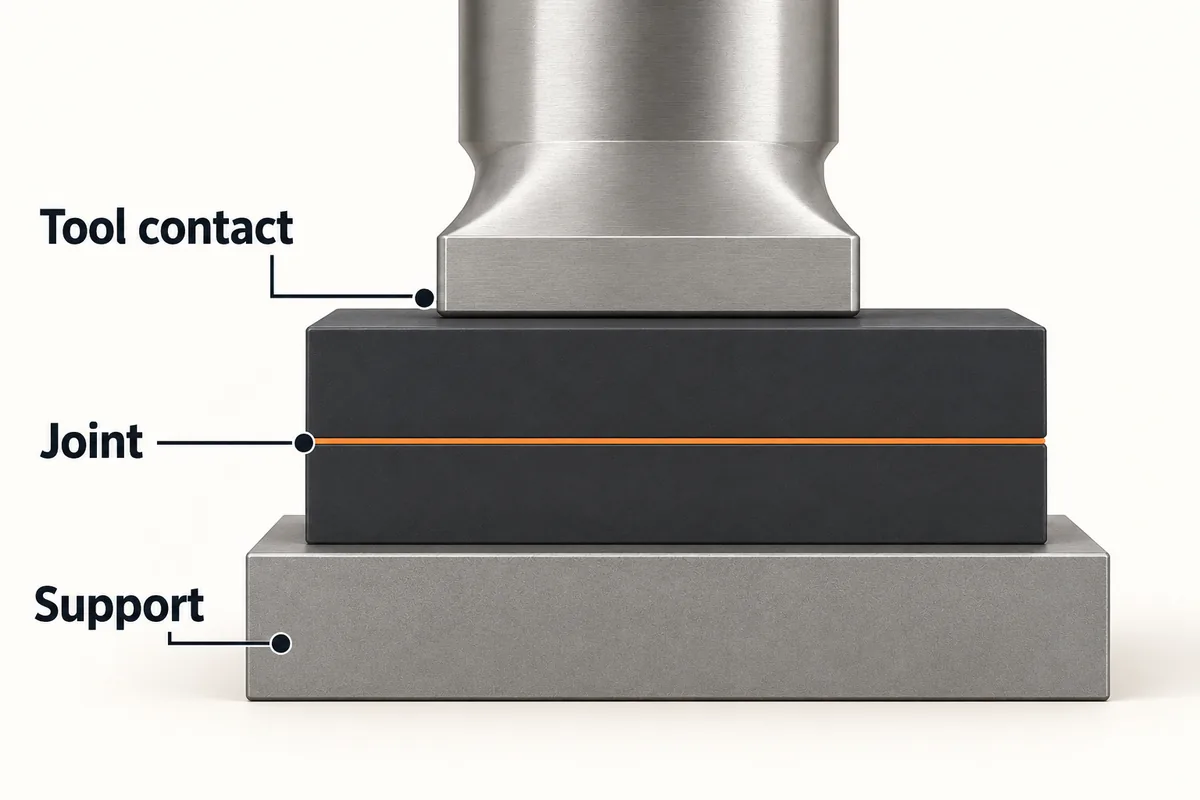
Illustration of ultrasonic tool access. Contact and support are shown; no joining method is selected and no actual Premier setup or validated joint is demonstrated.
Begin with the completed assembly. State what the joint must locate, retain, carry, seal or protect, and whether the parts must come apart for service. These requirements set the review; the process name does not define an accepted joint.
Download the blank worksheet (CSV).
Make the requirement visible
- Function.
Record before selecting a route: Required load, fit, seal or appearance, with its source.
If unresolved: Keep the affected requirement Open. - Parts.
Record before selecting a route: Both part revisions, exact materials and the mating interface.
If unresolved: Request the missing controlled definition. - Access and service.
Record before selecting a route: Assembly direction, tool access and any later removal requirement.
If unresolved: Ask the design owner to resolve the constraint. - Finished assembly.
Record before selecting a route: Applicable method, conditions and acceptance criterion.
If unresolved: Assign the criterion and evidence decision to a reviewer.
Treat each route as a proposal
In hot-plate welding of thermoplastics, a heated tool prepares the mating faces before the parts are brought together. Ultrasonic welding of thermoplastics uses vibration to generate heat at the plastic interface. These mechanisms require different engineering reviews; neither name proves a particular joint will meet its requirement.
TWI identifies material formulation and condition among the influences on ultrasonic weldability. Supply the exact material information rather than a family name alone. Ask how the proposed route addresses geometry, fixtures, access and later operations.
Keep the route and evidence together
- Give each requirement a stable ID and its controlling drawing or specification reference.
- Record each candidate route separately, including the proposed part and process revisions.
- Identify what the trial must demonstrate, its method and conditions, the acceptance source and the responsible reviewer.
- Link the actual report when it exists. Leave missing evidence blank and state the next action.
A component measurement and a finished-assembly check answer different questions. Record which construction each result represents. If a material, interface or joining route changes, ask the responsible reviewer which evidence needs reconsideration.
Explore our hot-plate welding and ultrasonic welding capabilities.
Review assembly and secondary operations and the component RFQ checklist. For a discussion, bring both mating parts, the required function and the open decision. Ask the team how to share controlled files.