
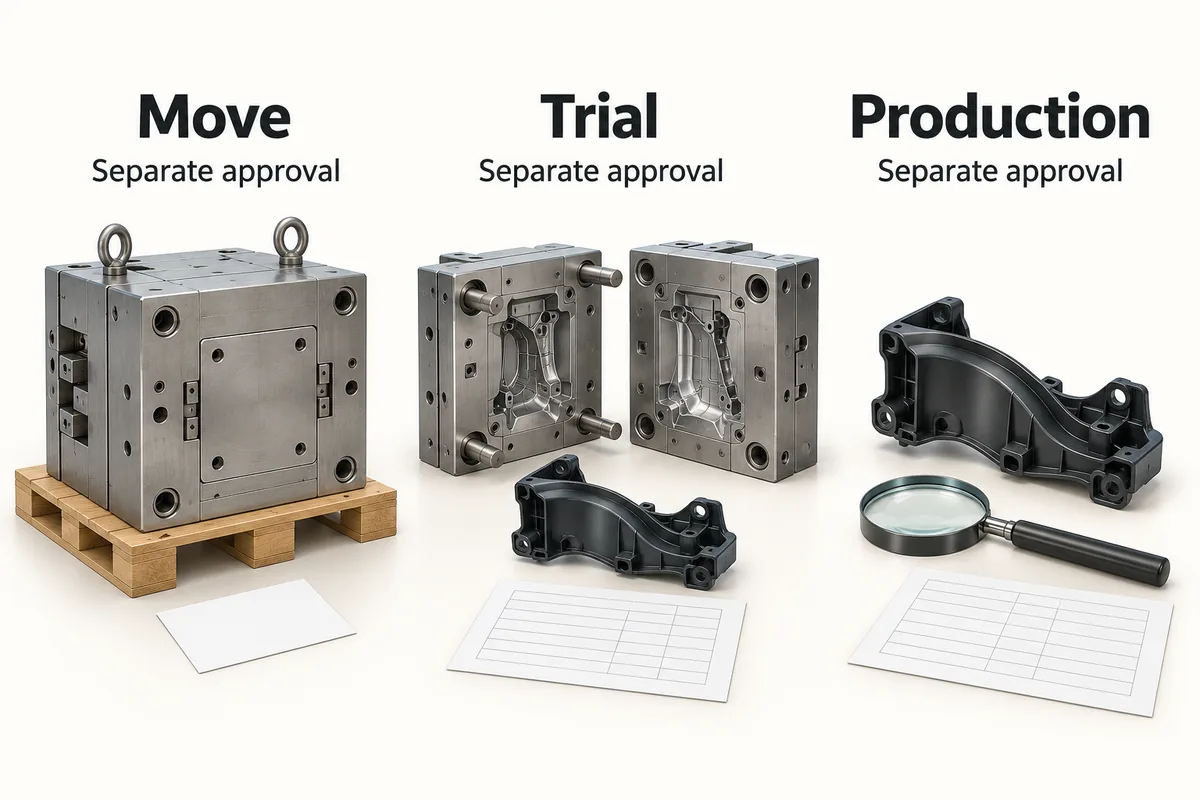
Illustration. Moving a tool, running a trial and releasing production require separate decisions. Not Premier equipment or an approved transfer.
Before moving an injection mould, collect its drawing, revision and history. Use this checklist to record missing evidence and who must approve each decision.
What to collect
- Identify the tool, part drawing and revision. Record which samples or reports define the required result.
- Bring the available condition, maintenance, correction and operating history. Mark missing records as open.
- State the requested scope: feasibility, quotation, a trial, correction or production review.
- Identify the proposed receiving route and the people responsible for technical, commercial and approval decisions.
Three separate decisions
Permission to move the tool, agreement to run a trial and approval to release production are separate decisions. Record the evidence and responsible person for each. A physical move alone does not establish that the receiving process has been accepted.
Transfer checklist
Use these ten checks in your transfer review. The download includes space for evidence, decision owners and open actions.
Download the blank transfer checklist (CSV). Open it in Excel or Google Sheets.
- Authority and scope. Who may authorise the move, changes and the requested supply scope?
- Tool identity. Tool ID, controlled revision, configuration and cavity identification.
- Condition and history. Known issues, maintenance record, corrections and trial or production history.
- Reference parts. Identified samples, drawings and records that define the required part.
- Receiving route. Proposed machine interfaces, services and responsible receiving reviewer.
- Responsibilities. Who covers inspection, trial, correction, transport, preservation and handover?
- Trial evidence. Agreed material, machine, cavity identification, conditions and report requirements.
- Acceptance. Applicable criteria, sample/report review and the person authorised to accept.
- Changes. Who approves corrections or deviations and updates the controlled records?
- Separate decisions. Open actions and the distinct permissions for a move, a trial and production release.
Close the gaps
For each missing item, name the information needed, who will provide it and which decision it affects. Keep an unresolved acceptance criterion separate from an actual failed result.
Agree how trial settings, material condition, cavity identity, samples and measured results will be recorded. Review corrections against those records. Keep the accepted part definition, tool revision and later changes connected.
Discuss your transfer
Start with the part, tool status, available history, proposed supply scope and the decision you need next. Ask how to share confidential drawings and records through an agreed channel.