

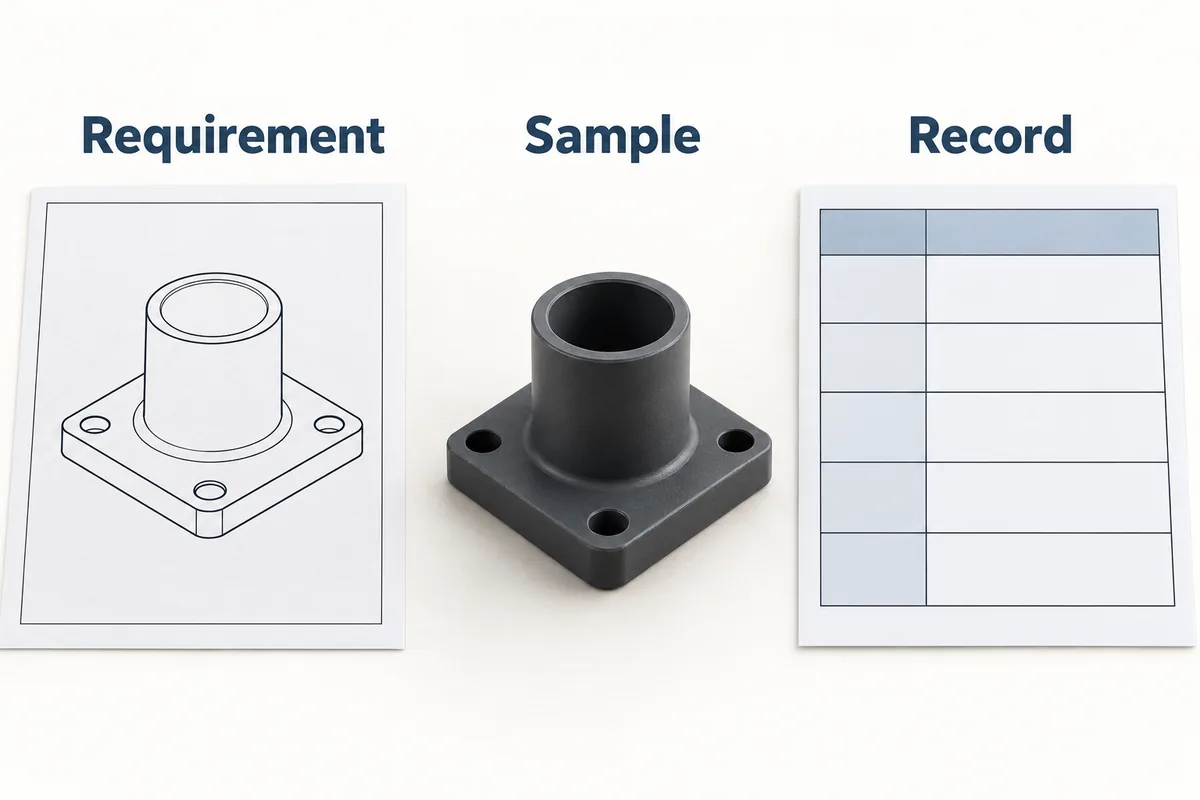
Illustration of a requirement, sample and record. No actual Premier drawing, test, result or approval is shown.
A test list tells you what someone plans to check. A validation matrix should also show which part was checked, against which requirement, under which conditions and who can accept the evidence. Give each requirement its own row.
Download the blank worksheet (CSV).
Start with a controlled construction
Identify the part and drawing revision, material, relevant process or assembly revision, and sample IDs. State whether the evidence is for development, a release decision or a routine control. These purposes should not be merged into one unexplained Pass column.
Blank evidence-to-decision matrix
Copy the structure into your review record. Select the rows that apply and record a reason for any exclusion. Every example row below is unfilled; Open is a planning state, not a test result.
No methods, conditions, acceptance sources, evidence, results or reviewer decisions have been supplied for these four requirements.
- Drawing characteristic, if applicable.
- Fit or assembly function, if applicable.
- Appearance or finish, if applicable.
- Exposure requirement, if applicable.
For each row record: requirement ID and source; specimen/construction revision; method and conditions; acceptance criterion and its authority; report reference; reviewer; decision and open action. Put the agreed values in the record rather than copying limits from an unrelated part.
Review the gap as well as the report
- A missing method or acceptance criterion remains Open even when a report has been supplied.
- Check that the report identifies the construction and conditions the requirement concerns.
- Where relevant, review measurement uncertainty against the decision needed. NIST explains that metrological traceability alone does not establish fitness for purpose.
- Keep an unresolved requirement separate from an actual failed result. Record the reviewer’s decision and required follow-up.
The NIST traceability guidance concerns measurement results. Keeping document and sample IDs linked is useful record control; it does not by itself establish metrological traceability or laboratory accreditation.
When the drawing, material, process or assembly changes, identify affected rows for review. Keep the original evidence reference and record the new decision; do not silently treat an earlier report as approval of the changed construction.
Use quality and validation for the manufacturing context and the component RFQ checklist for enquiry inputs. Bring the controlled definition and open matrix rows to the discussion.