

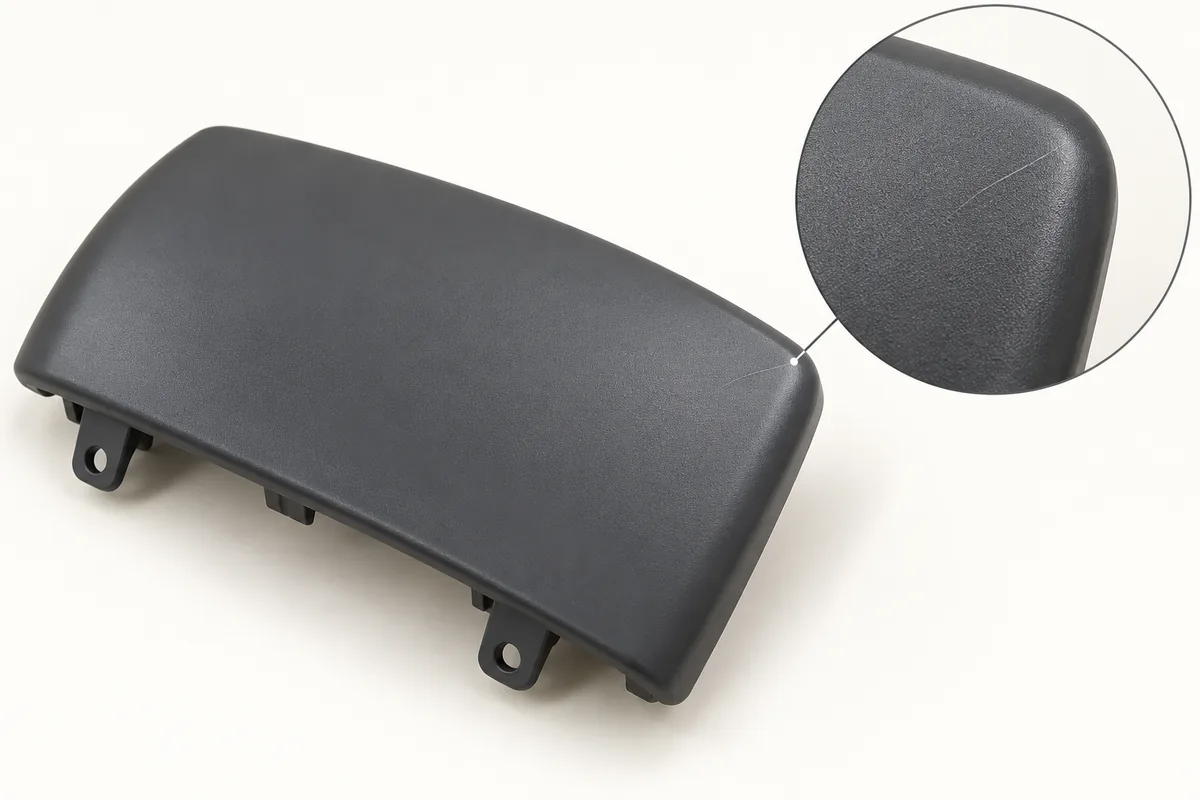
Illustration for appearance review. The mark is neither accepted nor rejected; actual criteria depend on the agreed reference and viewing conditions. Not a Premier sample.
Start with the actual part, its finish and the surfaces visible in use. Mark the appearance zones on a controlled drawing. Agree what each reference sample defines and who can resolve a borderline result before inspecting trial or production parts.
Download the blank worksheet (CSV).
A zone-by-zone appearance record
This record is blank. No entries have been supplied, and the decision remains Open.
- Surface zone. Drawing/revision and the boundary of the area being judged.
- Reference. Sample/specification ID, revision, authority and what it defines.
- Viewing arrangement. Agreed lighting, background, direction, distance and viewing time where specified.
- Acceptance. Applicable defect descriptions/limits and the source that approves them.
- Decision. Reviewer, finding, disposition and unresolved action.
Repeat the record for each relevant zone. Leave unagreed values Open. Do not supply a default viewing distance, scratch size, defect count or quality grade from an unrelated component.
Use the right comparison
ASTM D1729’s public scope describes controlled visual colour appraisal for diffusely illuminated opaque materials; special metallic and pearlescent viewing effects sit outside that scope. It is not a universal cosmetic-defect specification.
ISO 3668’s public abstract concerns comparison of paint-film colour against a reference under controlled illumination. Confirm the applicable method for the actual finish rather than applying a colour standard to every appearance question.
Keep the reference under control
- Record whether the reference defines colour, gloss, texture, a defect boundary or another stated feature.
- Identify the reference owner, revision, storage/protection and review or replacement rule.
- State how disagreements or suspected reference damage are escalated and recorded.
- Keep a photo’s purpose explicit. An explanatory photo is not automatically the authoritative acceptance reference.
Check the actual surface in the agreed condition. Record any cleaning, handling or packaging condition relevant to the comparison. Keep cosmetic decisions separate from the dimensional, coating-performance or functional evidence also required for the component.
Use the coating guide for coating-specific questions and quality and validation for the wider evidence review. Bring the part definition, appearance record and open points to the team.