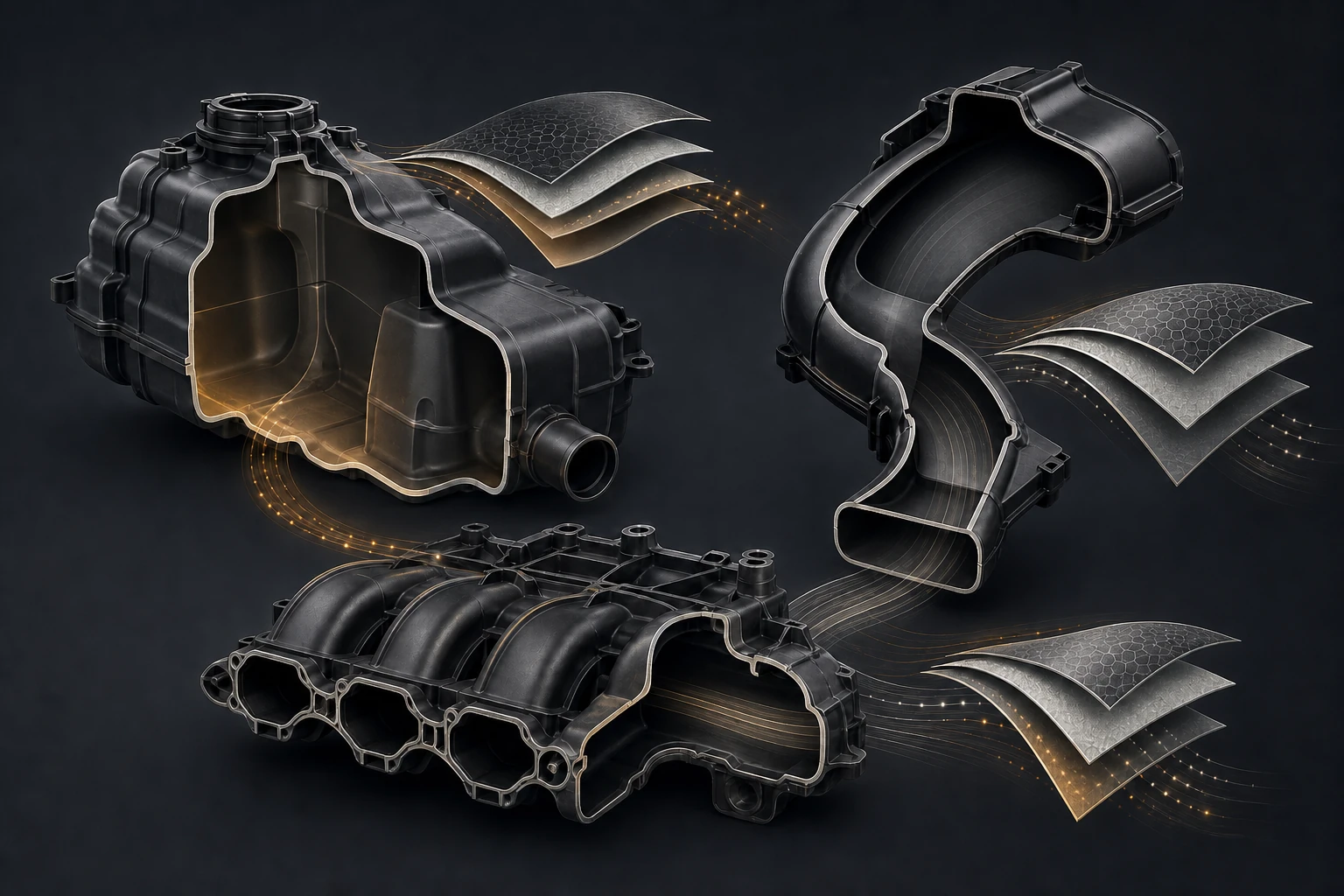
At Premier Plasmotec Private Limited, our Indian engineering, tooling, manufacturing and quality teams work together on plastic components. A fuel tank, HVAC duct and intake-manifold child part have different functions and supply boundaries. Select a process and validation plan for the actual component.
The essentials
- Map each component to its actual process.
- Treat material and barrier requirements as application-specific.
- Control ports, pinch-offs, welds and mating interfaces.
- Use leak, pressure, airflow or fit tests suited to the function.
Part function, process route and tank architecture
In extrusion blow moulding, a hollow molten-plastic tube, the parison, is expanded against the mould to form the part. Injection moulding is used for many detailed child parts, flanges, clips and interfaces; confirm the route for each component.
An intake-manifold child part should not be described as a blow-moulded manifold without evidence. Fuel contact, vapour control and regulatory needs drive material and barrier decisions.
Specify the required tank construction, including any layer structure and vapour-barrier requirement. Confirm the process against that construction. Leak integrity and vapour-permeation performance address different failure modes and need their own agreed evidence.
What to compare
| Area | Evidence to request |
|---|---|
| Component map | Name, function and actual manufacturing route |
| Material | Fluid or air duty and any barrier requirement |
| Geometry | Wall distribution, ports, mounts and joining features |
| Completion | Welding, inserts, trimming and assembly |
| Validation | Leak, pressure, airflow, fit and durability tests |
Wall distribution, joining and validation
Wall distribution in a blow-moulded part varies with geometry and process. Pinch-off regions require design and inspection attention.
Ports, necks and inserts must hold position and sealing geometry. HVAC ducts need package fit, joint retention and airflow-path control.
Joined parts require a defined welding or assembly process. Leak tests should state medium, pressure, stabilization, duration and limit.
Pressure or burst tests require agreed fixtures and safety controls. Dimensional checks should focus on mounts, ports and assembly datums.
Material and process traceability support failure analysis and change control.
Questions before choosing a supplier
- What is the confirmed manufacturing and secondary-operation route for each part?
- Which wall, port, pinch-off and joint characteristics govern functional approval?
- What fuel/fluid compatibility, layer structure or vapour-barrier requirement applies?
- Which leak, pressure, permeation, airflow or durability methods and limits apply to this component?
- What material, process or joining changes require repeat validation and updated traceability?
What to include in your request for quotation (RFQ)
- Component list/BOM with each part’s function, CAD/drawing revision and proposed manufacturing route.
- Fluid or air duty, temperature, market/customer requirements and approved material grade.
- Required layer/barrier structure, if any, and separate vapour-permeation acceptance requirements.
- Wall distribution, pinch-off, ports, necks, inserts, mounts and mating datums.
- Trimming, welding, joints, bought-out items and assembly responsibility.
- Applicable leak medium/pressure/fixture/time/limit plus separate pressure, flow, fit and durability methods.
- Demand, tooling status/ownership, material/process/joint traceability and controlled changes.
- Samples, approved construction evidence, handling and protective packaging.
If a requirement is still undecided, say so in the enquiry.
Specifications and references
- Use the customer’s drawing, material specification and agreed test standards to define the approval requirements.
Use the evidence in your supplier review
For a quotation, keep the drawing revision, material, test requirement and supply responsibility aligned across every offer. Where a requirement is still being developed, identify the open decision and its owner rather than comparing one supplier’s assumption with another supplier’s confirmed scope.
Related manufacturing and buyer resources
Fuel-tank construction requirements; HVAC duct component scope; Intake-manifold child parts.
Start an engineering discussion
Describe the application, drawing status, expected demand and programme timing through our manufacturing enquiry page. Ask the team how to share confidential drawings or samples through an agreed channel.