

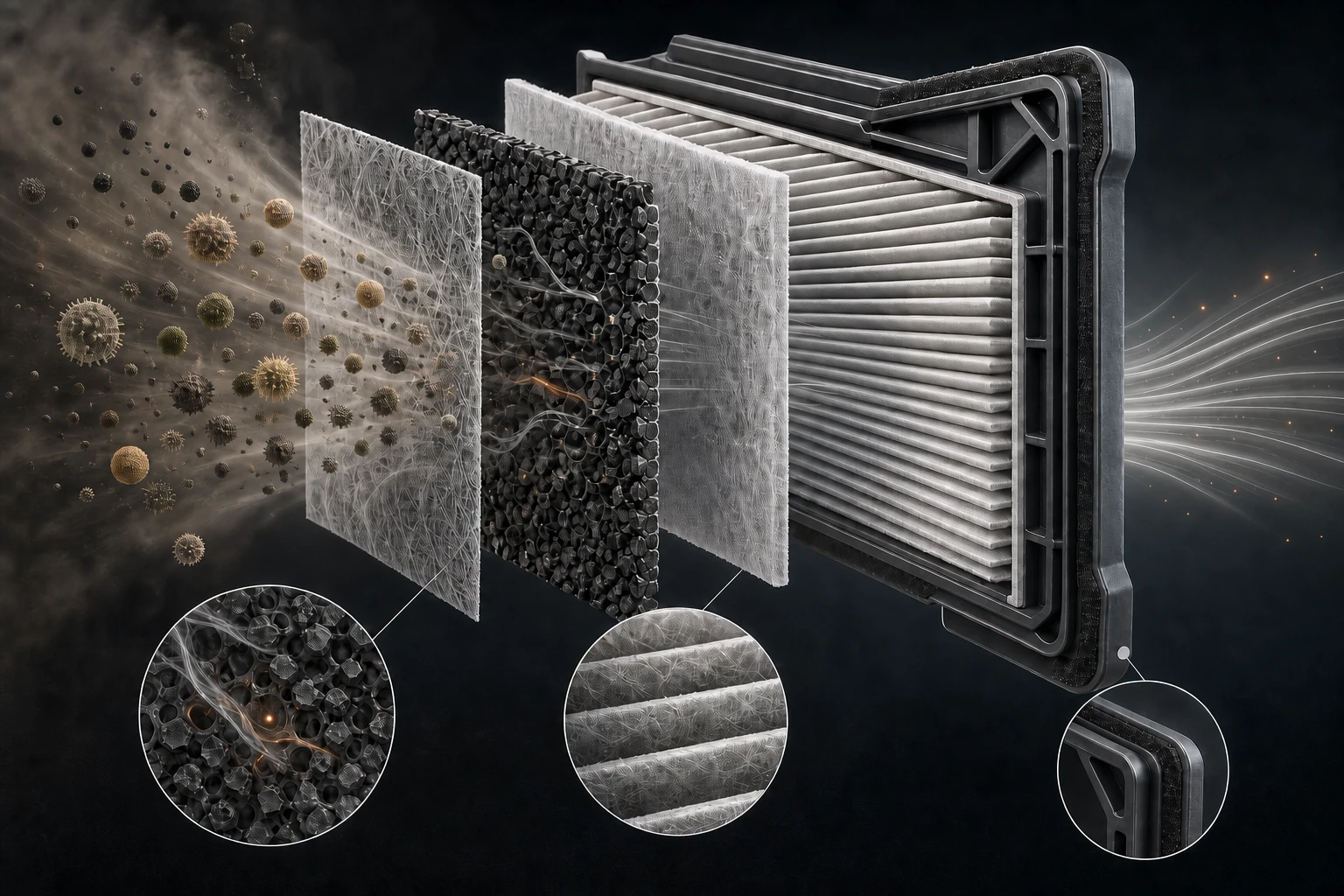
“PM2.5” and “activated carbon” describe different filtration objectives. Fine-particle capture concerns particulate matter; activated carbon is used for selected gaseous contaminants and odours. One claim does not prove the other.
For OEM procurement, product engineering and supplier-quality teams, the strongest sourcing decision comes from linking the part requirement to a practical manufacturing and validation plan. This guide explains what to specify, what to verify and what to include in the RFQ.
The essentials
- Separate particulate and gaseous requirements.
- Specify airflow and allowable pressure loss.
- Control frame sealing so air cannot bypass the media.
- Demand test reports with the exact challenge and method.
What PM2.5 and activated-carbon labels actually mean
PM2.5 describes an aerodynamic particle-size fraction, not a guaranteed filter efficiency. Particle capture depends on media structure, particle size, airflow and loading state.
Particulate filtration layers and fibre/media decisions
A multilayer particulate medium may balance efficiency, holding capacity and resistance. Pleat geometry determines usable area and local flow distribution.
Activated carbon and gaseous filtration objectives
Activated carbon adsorbs selected gases; performance depends on carbon type, mass and exposure. A carbon layer alone does not prove removal of a named gas.
What to compare
| Area | Evidence to request |
|---|---|
| Particulate | Particle-size target, method and efficiency report |
| Gaseous | Named gas, challenge, method and adsorption result |
| Airflow | Duty point and allowable pressure loss |
| Construction | Media layers, pleats, frame and seals |
| Fit | Envelope, orientation, bypass control and service life |
Keep particulate and gaseous filtration evidence separate
Particulate efficiency cannot be used as evidence of gaseous filtration. Gaseous test results cannot substitute for particle-size efficiency data.
Frame sealing, bypass and installation direction
Frame distortion or poor seals can allow unfiltered bypass air. Installation direction and vehicle fit should be clear to the service technician.
Compare pressure loss at the same test condition
Pressure loss should be compared at the same airflow and element condition. Loaded performance may differ from initial laboratory results.
Questions worth asking before nomination
- Which input assumptions could change the tool, process route or quoted price?
- Which characteristics are controlled by process settings, and which require inspection of every part or lot?
- What will be measured during trials, and who approves the result?
- How are material, cavity, machine, assembly and inspection records connected?
- What happens when a drawing, material or demand profile changes after nomination?
Claims should state method, challenge, duty point and specimen identity. The RFQ should list particle and gas targets separately. These questions turn a capability discussion into a clear technical and commercial responsibility map.
How Premier supports this work
Premier’s portfolio includes cabin-filter examples identified as PM2.5, activated-carbon and cabin-air-filter products, together with air-filter performance-test evidence. Published performance values should always come from an approved report for the exact element.
Premier’s engineering, tooling, manufacturing and quality teams can review the requirement against the drawing, material, production volume and agreed validation plan. The useful starting point is the component data, not a generic capability question.
What to include in the RFQ
- Controlled 3D CAD and the latest drawing revision.
- Component function, mating interfaces and critical characteristics.
- Exact material grade, or the service conditions if material selection is open.
- Annual volume, peak demand, programme timing and target production location.
- Existing tooling status, target machine interfaces and ownership requirements.
- Appearance zones, packaging expectations and traceability requirements.
- Applicable customer specifications, standards and validation methods.
- Samples, mating parts and previous failure information where available.
A complete input pack shortens feasibility review and makes quotations easier to compare. If a value is not yet fixed, identify it as an open engineering decision and provide the condition it must satisfy.
Start a technical review
Send the drawing, material requirement, expected volume and validation plan through Premier’s manufacturing enquiry page. The relevant engineering, tooling, manufacturing and quality teams can then review the part and respond against the actual scope.