

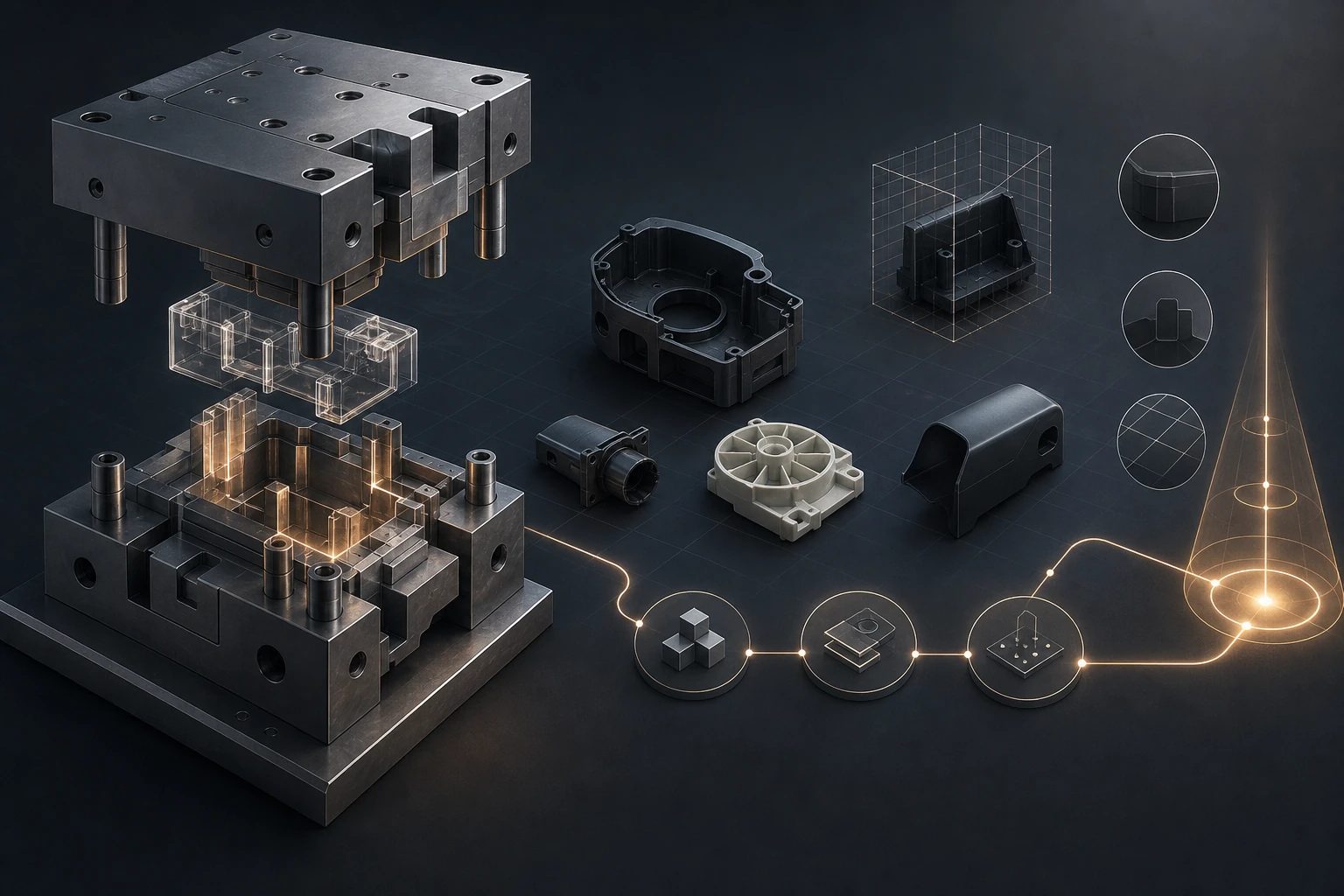
Choosing an injection-moulding supplier is not a machine-shopping exercise. The real question is whether one team can carry a component from an agreed drawing through tooling, trials, production, inspection and controlled change.
For OEM procurement, product engineering and supplier-quality teams, the strongest sourcing decision comes from linking the part requirement to a practical manufacturing and validation plan. This guide explains what to specify, what to verify and what to include in the RFQ.
The essentials
- Start with the part function and critical interfaces, not tonnage alone.
- Separate tool capability from serial-production capability.
- Ask for evidence that follows the same drawing revision from DFM to inspection.
- Make capacity, maintenance and change control part of the commercial comparison.
Drawing characteristics to define before tool release
Translate functional requirements into measurable drawing characteristics. Review wall thickness, ribs, bosses, draft, undercuts and visible surfaces before tool release.
Material selection and machine fit
Select resin by service conditions, regulatory needs and approved grade – not polymer family alone. Match projected area, shot size, mould dimensions and process window to the proposed machine.
Gate position, cooling and dimensional stability
Define gate position around filling, weld lines, appearance and trimming risk. Review cooling balance because it affects cycle stability, warpage and dimensional repeatability.
What to compare
| Area | Evidence to request |
|---|---|
| Part and DFM | Marked drawing, 3D data and open-point list |
| Tooling | Tool concept, trial plan and maintenance responsibility |
| Production | Proposed machine, material handling and process controls |
| Quality | Inspection method, report format and traceability |
| Supply | Capacity basis, packaging and change control |
Tool-design ownership and staged production trials
Confirm who owns mouldflow, tool design, steel selection and design changes. Use staged trials with recorded settings, material condition and measured results.
Steel-safe dimensions and the correction route
Agree steel-safe dimensions and the correction route before cutting final geometry. Connect the control plan to critical characteristics and known process risks.
Traceability, maintenance and tool-life responsibilities
Ask how resin lots, process settings, cavities and inspection results are traced. Review preventive maintenance, spare inserts and tool-life responsibilities.
Capacity assumptions and packaging requirements
Compare available capacity using the required cycle, cavitation, uptime and peak demand. Define packaging from surface protection, part orientation and transport loads.
Deviation control and a comparable RFQ scope
Require a clear deviation and engineering-change process for serial supply. Send a controlled RFQ pack so every bidder prices the same scope.
Questions worth asking before nomination
- Which input assumptions could change the tool, process route or quoted price?
- Which characteristics are controlled by process settings, and which require inspection of every part or lot?
- What will be measured during trials, and who approves the result?
- How are material, cavity, machine, assembly and inspection records connected?
- What happens when a drawing, material or demand profile changes after nomination?
Require a clear deviation and engineering-change process for serial supply. Send a controlled RFQ pack so every bidder prices the same scope. These questions turn a capability discussion into a clear technical and commercial responsibility map.
How Premier supports this work
Premier Plasmotec brings product engineering, in-house mould making, moulding, assembly and inspection together for automotive and industrial plastic components. That connected route allows a buyer to discuss the part, mould and production plan with one manufacturing team.
Premier’s engineering, tooling, manufacturing and quality teams can review the requirement against the drawing, material, production volume and agreed validation plan. The useful starting point is the component data, not a generic capability question.
What to include in the RFQ
- Controlled 3D CAD and the latest drawing revision.
- Component function, mating interfaces and critical characteristics.
- Exact material grade, or the service conditions if material selection is open.
- Annual volume, peak demand, programme timing and target production location.
- Existing tooling status, target machine interfaces and ownership requirements.
- Appearance zones, packaging expectations and traceability requirements.
- Applicable customer specifications, standards and validation methods.
- Samples, mating parts and previous failure information where available.
A complete input pack shortens feasibility review and makes quotations easier to compare. If a value is not yet fixed, identify it as an open engineering decision and provide the condition it must satisfy.
Start a technical review
Send the drawing, material requirement, expected volume and validation plan through Premier’s manufacturing enquiry page. The relevant engineering, tooling, manufacturing and quality teams can then review the part and respond against the actual scope.
Related capabilities
Technical references
- Customer drawing, material specification and applicable validation standards should remain the controlling technical references.