

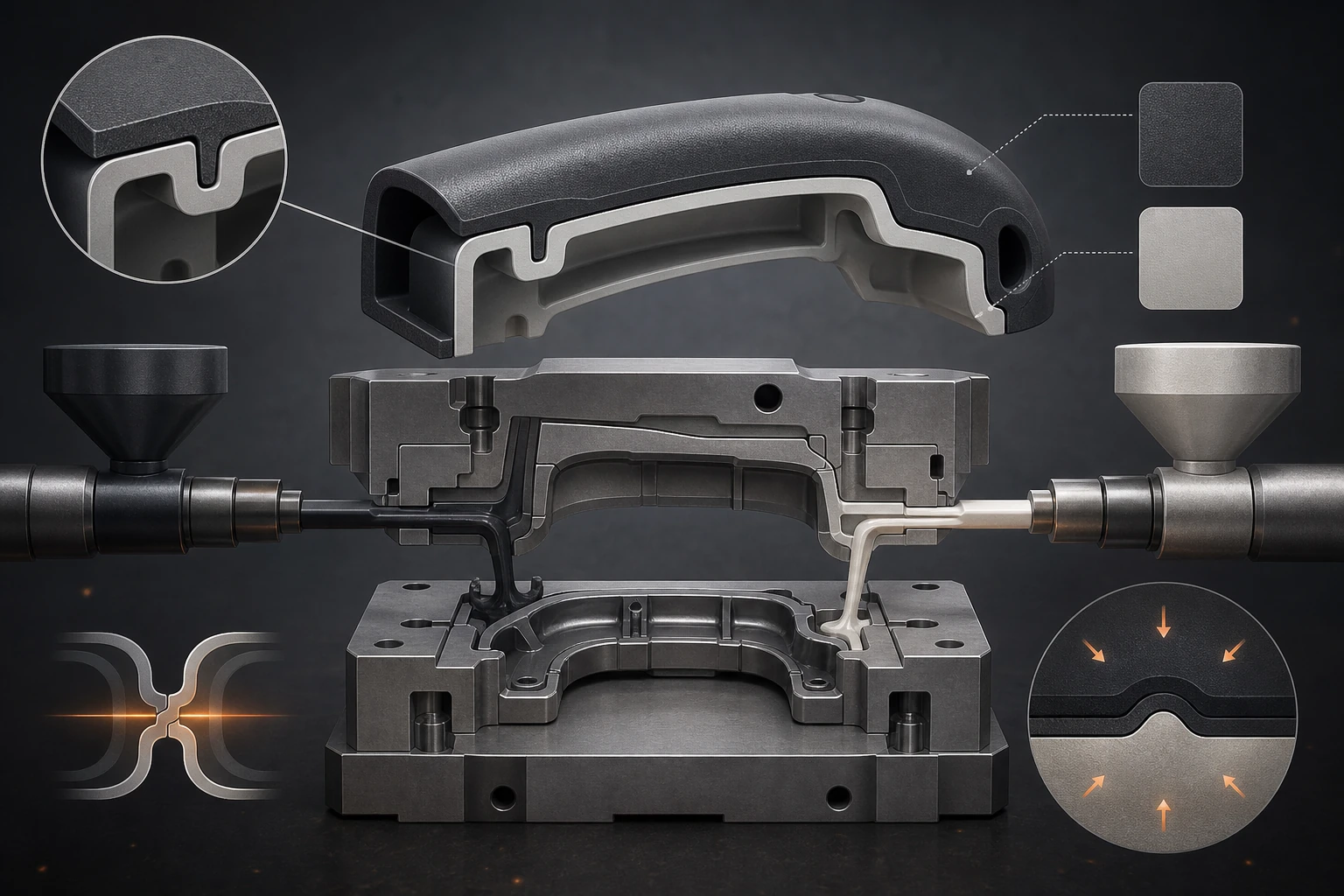
Two-shot moulding can combine colours, textures, seals or rigid and soft functions in one component. It succeeds only when material compatibility, interface geometry, shot sequence, tooling and process control are designed as one system.
For OEM procurement, product engineering and supplier-quality teams, the strongest sourcing decision comes from linking the part requirement to a practical manufacturing and validation plan. This guide explains what to specify, what to verify and what to include in the RFQ.
The essentials
- Prove chemical compatibility or design a mechanical lock.
- Design the first shot to survive transfer and the second injection event.
- Choose the machine and tool concept together.
- Validate the interface, appearance and function after realistic conditioning.
Material-pair adhesion must be demonstrated
Two materials touching does not guarantee adhesion. Supplier data, trials and the end-use environment should support the material pair.
Mechanical interlocks and interface flow paths
Mechanical interlocks can provide retention where chemical bonding is insufficient. The interface needs enough area and a flow path that does not trap air.
First-shot location and transfer architecture
The first shot must locate repeatably without distortion during transfer. Rotating-platen, index-plate, core-back and transfer concepts solve different geometries.
What to compare
| Area | Evidence to request |
|---|---|
| Materials | Exact grades and compatibility evidence |
| Interface | Bonding objective or mechanical lock |
| Sequence | First shot, transfer and second-shot plan |
| Tool and machine | Indexing concept and interface requirements |
| Approval | Appearance, bond, dimension and functional tests |
Shut-offs and second-shot deformation risk
Tool shut-offs must control flash without damaging the first material. Second-shot temperature and pressure can deform or remelt sensitive features.
Gate vestige, witness lines and colour control
Gate vestige and witness lines should sit outside critical appearance or sealing zones. Colour change and contamination control matter for visible two-colour parts.
Cavity balance and sequence trials
The cavity balance and sequence must be checked across every cavity. Trials should isolate material, interface, sequence and process-window effects.
Bond testing and assembled-interface inspection
Bond or peel tests need geometry and acceptance criteria agreed by the customer. Dimensional inspection should include the assembled interface, not only each material.
Questions worth asking before nomination
- Which input assumptions could change the tool, process route or quoted price?
- Which characteristics are controlled by process settings, and which require inspection of every part or lot?
- What will be measured during trials, and who approves the result?
- How are material, cavity, machine, assembly and inspection records connected?
- What happens when a drawing, material or demand profile changes after nomination?
Automation can improve handling, but the required orientation and checks must be specified. An RFQ needs both grades, interface purpose, colours, tests, volume and target machine standard. These questions turn a capability discussion into a clear technical and commercial responsibility map.
How Premier supports this work
Premier’s manufacturing processes cover twin-shot routes, including rotating-platen and vertical-barrel configurations. The suitable configuration depends on the part geometry, material pair, interface and production volume.
Premier’s engineering, tooling, manufacturing and quality teams can review the requirement against the drawing, material, production volume and agreed validation plan. The useful starting point is the component data, not a generic capability question.
What to include in the RFQ
- Controlled 3D CAD and the latest drawing revision.
- Component function, mating interfaces and critical characteristics.
- Exact material grade, or the service conditions if material selection is open.
- Annual volume, peak demand, programme timing and target production location.
- Existing tooling status, target machine interfaces and ownership requirements.
- Appearance zones, packaging expectations and traceability requirements.
- Applicable customer specifications, standards and validation methods.
- Samples, mating parts and previous failure information where available.
A complete input pack shortens feasibility review and makes quotations easier to compare. If a value is not yet fixed, identify it as an open engineering decision and provide the condition it must satisfy.
Start a technical review
Send the drawing, material requirement, expected volume and validation plan through Premier’s manufacturing enquiry page. The relevant engineering, tooling, manufacturing and quality teams can then review the part and respond against the actual scope.
Related capabilities
Technical references
- Customer drawing, material specification and applicable validation standards should remain the controlling technical references.