

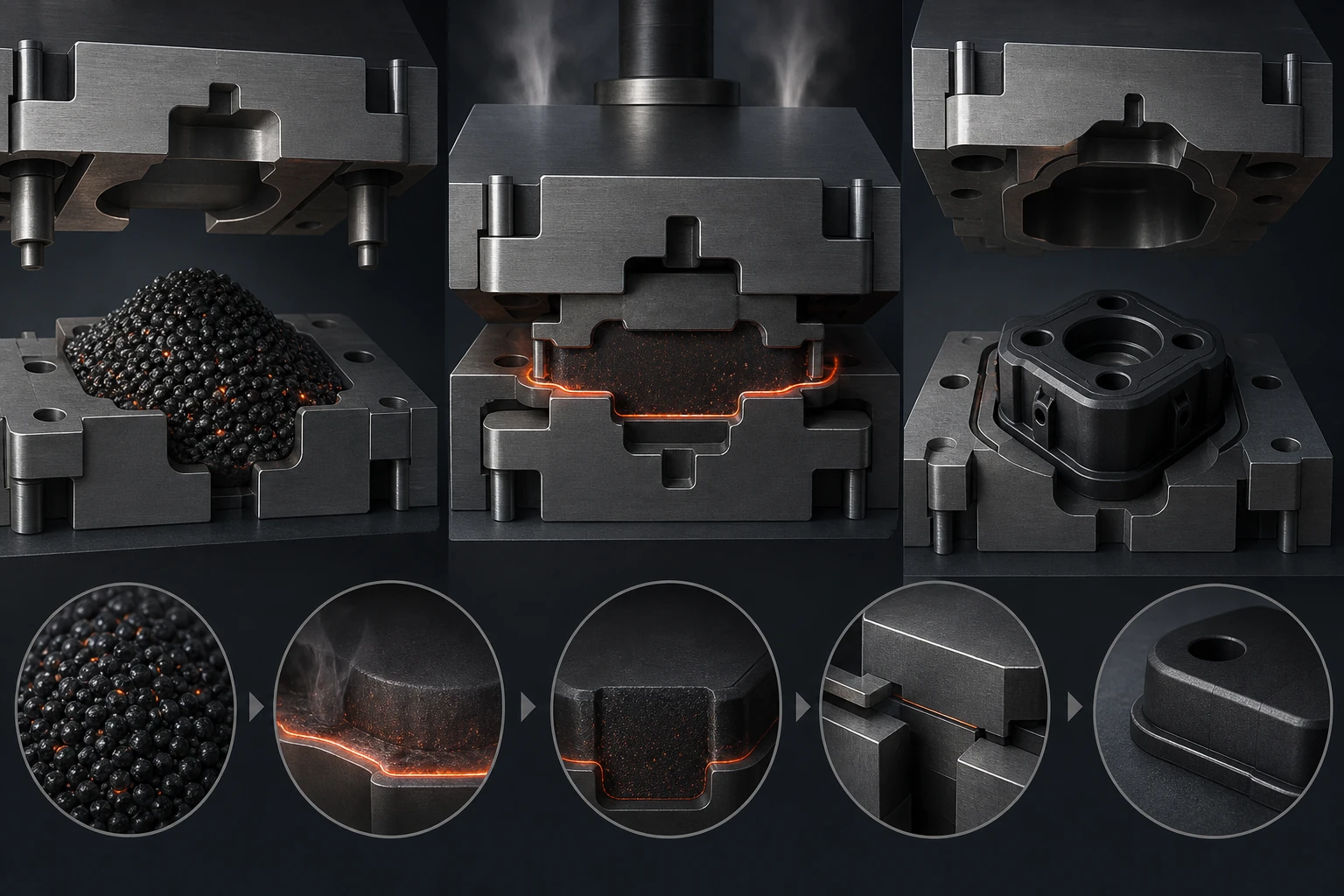
Thermoset and Bakelite components are selected where the specified compound offers the required heat, electrical, dimensional or chemical behaviour. Their compression-moulding process differs fundamentally from remelting thermoplastics.
For OEM procurement, product engineering and supplier-quality teams, the strongest sourcing decision comes from linking the part requirement to a practical manufacturing and validation plan. This guide explains what to specify, what to verify and what to include in the RFQ.
The essentials
- Choose the exact compound for the application.
- Control charge, temperature, pressure and cure.
- Design vents, flash lands and inserts for compression moulding.
- Validate grade-specific performance rather than relying on the word “Bakelite”.
Thermoset cure behaviour and grade-specific properties
Thermosets crosslink during cure and cannot be remelted like thermoplastics. The compound grade determines the relevant thermal, electrical and mechanical properties.
Compound storage, charge mass and placement
Material storage and shelf-life controls should follow supplier requirements. Charge mass and placement influence fill, knit lines and trapped air.
Preheating, mould temperature, pressure and cure time
Preheating or preforming may be used where the approved process requires it. Mould temperature, pressure and cure time work together.
What to compare
| Area | Evidence to request |
|---|---|
| Application | Temperature, electrical, chemical and load conditions |
| Compound | Exact grade, storage and preparation |
| Tooling | Charge, vents, flash lands and insert location |
| Process | Temperature, pressure, cure and any post-cure |
| Evidence | Dimensions and grade-specific functional tests |
Venting, flash and stress-sensitive part design
Venting must release air and volatiles without uncontrolled flash. Part design should avoid abrupt sections that concentrate stress.
Insert location and controlled flash removal
Metal inserts need controlled location, pre-treatment and movement checks. Flash removal must protect critical edges, threads and surfaces.
Cure defects, porosity and post-cure requirements
Incomplete cure, blisters, cracks and porosity need defined rejection criteria. Post-cure should be specified only when required for the selected compound.
Conditioned measurement and grade-specific test evidence
Dimensions may need a defined conditioning time before measurement. Temperature, dielectric, flame and chemical claims require grade-specific evidence.
Questions worth asking before nomination
- Which input assumptions could change the tool, process route or quoted price?
- Which characteristics are controlled by process settings, and which require inspection of every part or lot?
- What will be measured during trials, and who approves the result?
- How are material, cavity, machine, assembly and inspection records connected?
- What happens when a drawing, material or demand profile changes after nomination?
Tool maintenance should address vents, flash lands and cavity condition. The RFQ should state environment, compound, inserts, tests and demand. These questions turn a capability discussion into a clear technical and commercial responsibility map.
How Premier supports this work
Premier’s manufacturing processes include compression moulding for thermoset and Bakelite applications. The right discussion begins with the drawing, operating environment and specified compound grade.
Premier’s engineering, tooling, manufacturing and quality teams can review the requirement against the drawing, material, production volume and agreed validation plan. The useful starting point is the component data, not a generic capability question.
What to include in the RFQ
- Controlled 3D CAD and the latest drawing revision.
- Component function, mating interfaces and critical characteristics.
- Exact material grade, or the service conditions if material selection is open.
- Annual volume, peak demand, programme timing and target production location.
- Existing tooling status, target machine interfaces and ownership requirements.
- Appearance zones, packaging expectations and traceability requirements.
- Applicable customer specifications, standards and validation methods.
- Samples, mating parts and previous failure information where available.
A complete input pack shortens feasibility review and makes quotations easier to compare. If a value is not yet fixed, identify it as an open engineering decision and provide the condition it must satisfy.
Start a technical review
Send the drawing, material requirement, expected volume and validation plan through Premier’s manufacturing enquiry page. The relevant engineering, tooling, manufacturing and quality teams can then review the part and respond against the actual scope.
Related capabilities
Technical references
- Customer drawing, material specification and applicable validation standards should remain the controlling technical references.