

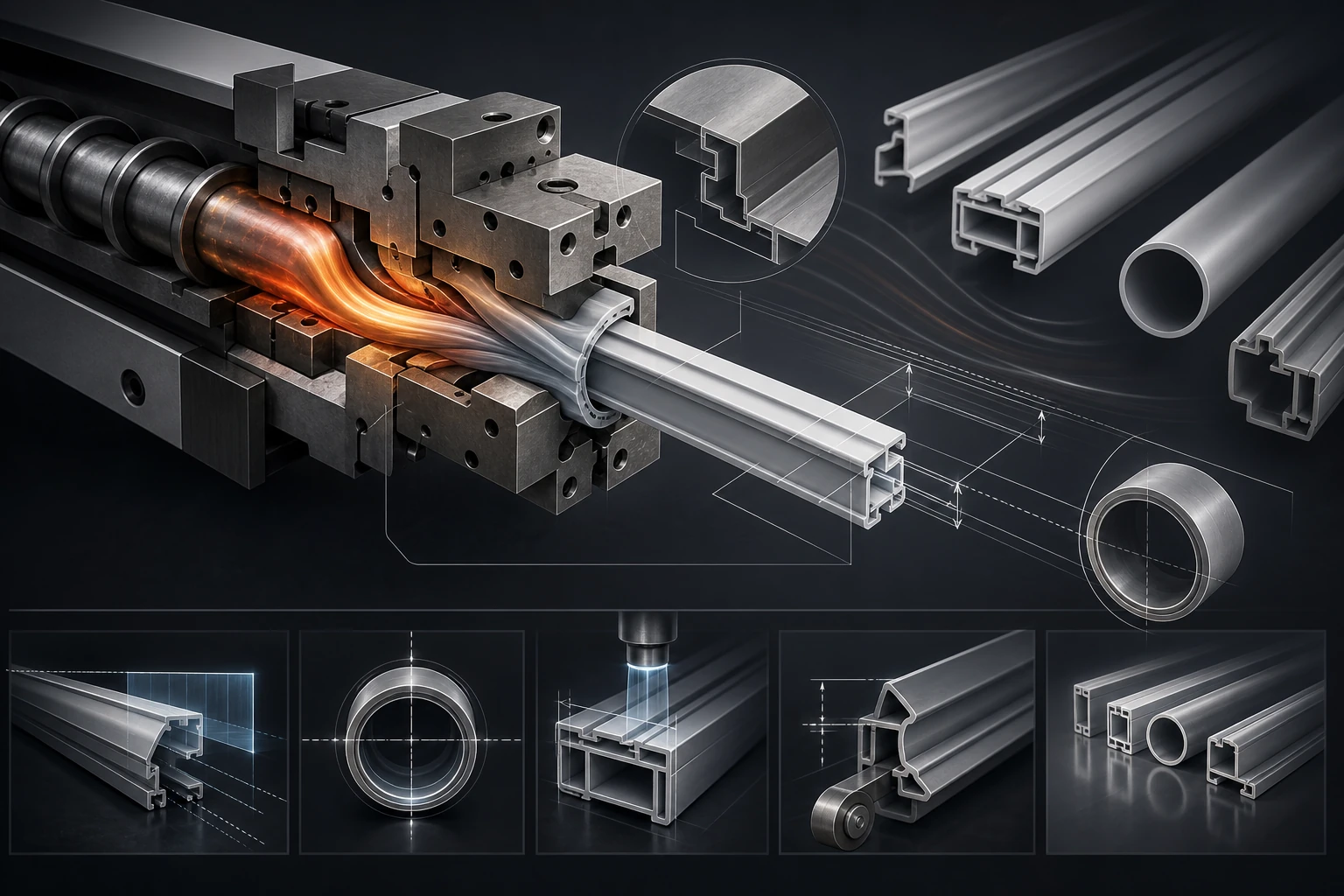
PVC profiles, tubes and moulded parts may use the same polymer family, but they are not the same manufacturing problem. Geometry, compound behaviour, tooling, cooling and measurement must be defined for the actual process.
For OEM procurement, product engineering and supplier-quality teams, the strongest sourcing decision comes from linking the part requirement to a practical manufacturing and validation plan. This guide explains what to specify, what to verify and what to include in the RFQ.
The essentials
- Identify extrusion or moulding explicitly.
- Specify the compound or required properties, not simply “PVC”.
- Control the profile after it leaves the die; cooling and haul-off matter.
- Agree how dimensions, cut length, appearance and packaging will be checked.
What Premier means by PVC processing
Rigid and flexible PVC require different compound and processing decisions. State colour, finish, hardness or flexibility only through an approved specification.
Ask the supplier to show how these requirements appear in the drawing review, process plan and inspection record. If the design is still open, agree the trial or analysis that will settle it.
When extrusion, injection moulding or another route is appropriate
For extrusion, the die shapes a continuous section rather than an individual cavity-moulded part. Die swell and material draw-down must be considered when finalising tooling.
Compare proposals on the same input revision. A technically stronger quotation makes assumptions visible and explains what must happen before the part can be approved for serial production.
PVC compound and application inputs that change the process
Calibration and cooling stabilise external dimensions after the profile leaves the die. Haul-off speed interacts with line speed, wall thickness and dimensional consistency.
Acceptance criteria should identify the specimen condition, method, sampling plan and responsible approver. That prevents a general capability statement from being mistaken for product evidence.
What to compare
| Area | Evidence to request |
|---|---|
| Geometry | Section drawing, tolerances and mating features |
| Material | Approved compound or functional specification |
| Line control | Die, calibration, cooling and haul-off plan |
| Inspection | Section, cut-length and appearance checks |
| Supply | Coil or cut format, packaging and annual demand |
Die, calibration, cooling and cut-length considerations
Cutting or coiling must preserve length, end condition and straightness. Hollow sections need checks for wall distribution and internal collapse.
This decision also affects tooling cost, trial time and long-term repeatability. Resolve it before tool release wherever possible; later correction is usually slower and more expensive.
Dimensional, surface and batch quality controls
Mating profiles should be assessed with the actual adjoining component or gauge. Inspection should reference stable datums and a conditioned sample where appropriate.
Ask the supplier to show how these requirements appear in the drawing review, process plan and inspection record. If the design is still open, agree the trial or analysis that will settle it.
Evidence an OEM or industrial buyer should request
Surface streaks, burn, contamination and colour drift need agreed visual limits. Material storage and regrind rules should be documented for the selected compound.
Compare proposals on the same input revision. A technically stronger quotation makes assumptions visible and explains what must happen before the part can be approved for serial production.
Frequently asked questions
Packaging must prevent bending, crushing, marking and heat distortion in transit. Tool maintenance should include die cleaning and dimensional verification.
Acceptance criteria should identify the specimen condition, method, sampling plan and responsible approver. That prevents a general capability statement from being mistaken for product evidence.
Questions worth asking before nomination
- Which input assumptions could change the tool, process route or quoted price?
- Which characteristics are controlled by process settings, and which require inspection of every part or lot?
- What will be measured during trials, and who approves the result?
- How are material, cavity, machine, assembly and inspection records connected?
- What happens when a drawing, material or demand profile changes after nomination?
Sampling frequency should reflect start-up, changeover and steady production risks. An RFQ should include a section drawing, compound requirement, cut length and demand. These questions turn a capability discussion into a clear technical and commercial responsibility map.
How Premier supports this work
Premier’s approved manufacturing content includes extrusion for verified PVC tubes and profiles, alongside compression and injection-moulding routes for other component families. Buyers should send the actual section and application so the correct route can be confirmed.
Premier’s engineering, tooling, manufacturing and quality teams can review the requirement against the drawing, material, production volume and agreed validation plan. The useful starting point is the component data, not a generic capability question.
What to include in the RFQ
- Controlled 3D CAD and the latest drawing revision.
- Component function, mating interfaces and critical characteristics.
- Exact material grade, or the service conditions if material selection is open.
- Annual volume, peak demand, programme timing and target production location.
- Existing tooling status, target machine interfaces and ownership requirements.
- Appearance zones, packaging expectations and traceability requirements.
- Applicable customer specifications, standards and validation methods.
- Samples, mating parts and previous failure information where available.
A complete input pack shortens feasibility review and makes quotations easier to compare. If a value is not yet fixed, identify it as an open engineering decision and provide the condition it must satisfy.
Start a technical review
Send the drawing, material requirement, expected volume and validation plan through Premier’s manufacturing enquiry page. The relevant engineering, tooling, manufacturing and quality teams can then review the part and respond against the actual scope.
Related capabilities
Technical references
- Customer drawing, material specification and applicable validation standards should remain the controlling technical references.